
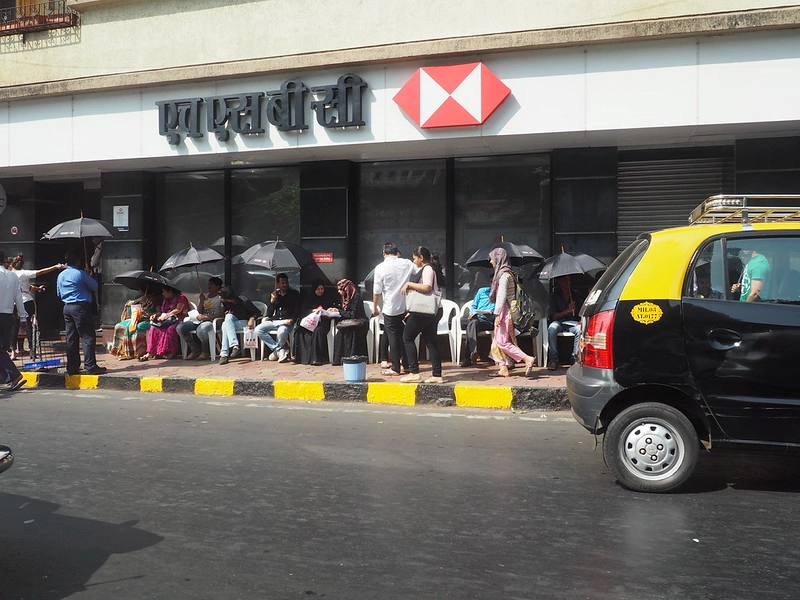
“Demonetisation queues” by Scott Edmunds, CC BY 2.0
What is income [[tax::Money paid by people to the government for public services.]] and who has to pay it
Every person who makes more money than a certain amount has to pay tax in India. One of the many types of taxes is income tax. Income tax is the amount of tax a person pays depending on how much money they earn.
Demonetisation is a process that the government uses to check whether people have paid the correct amount of income tax. It is [[illegal::Something that is not legal or not allowed.]] to pay less than the correct amount of income tax
What happens during a demonetisation?
When demonetisation happens, the government stops the use of some [[currency :: Money used in a country to buy goods and services.]] notes. They cannot be used to make any purchases. To use this money again, these old notes have to be exchanged with new ones given by the government.
The government keeps a track of how much money a person exchanges. This helps the government to identify people who are exchanging more money than the money on which they have paid income tax. The government may ask such people questions on why they did not pay the correct amount of income tax.
When did the recent demonetisation take place?
On 8 November 2016, Narendra Modi, Prime Minister of India, announced that the currency notes of Rs. 500 and Rs. 1,000 would be demonetised from midnight. People could exchange these notes with new notes of Rs. 500 and Rs. 2,000. Further, people who had money on which tax had not been paid would be fined 200% of the tax.
What was the impact of the recent demonetisation?
People rushed to banks and post offices where currency notes could be exchanged. People often stood outside banks for hours waiting to exchange their old notes. Since physical notes were unavailable due to high demand, the demonetisation also led to a growth of electronic payment methods.
Quick Revision
Income Tax: Tax paid by people who earn above a certain limit; paying less is illegal.
Demonetisation Purpose: Done to check black money and unpaid taxes.
Process: Old notes become invalid and must be exchanged for new ones; government tracks exchanges.
2016 Event: On 8 Nov 2016, ₹500 & ₹1,000 notes banned; new ₹500 & ₹2,000 notes introduced; heavy fines for tax evasion.
Impact: Long bank queues, cash shortage, and rise in digital payments.


