
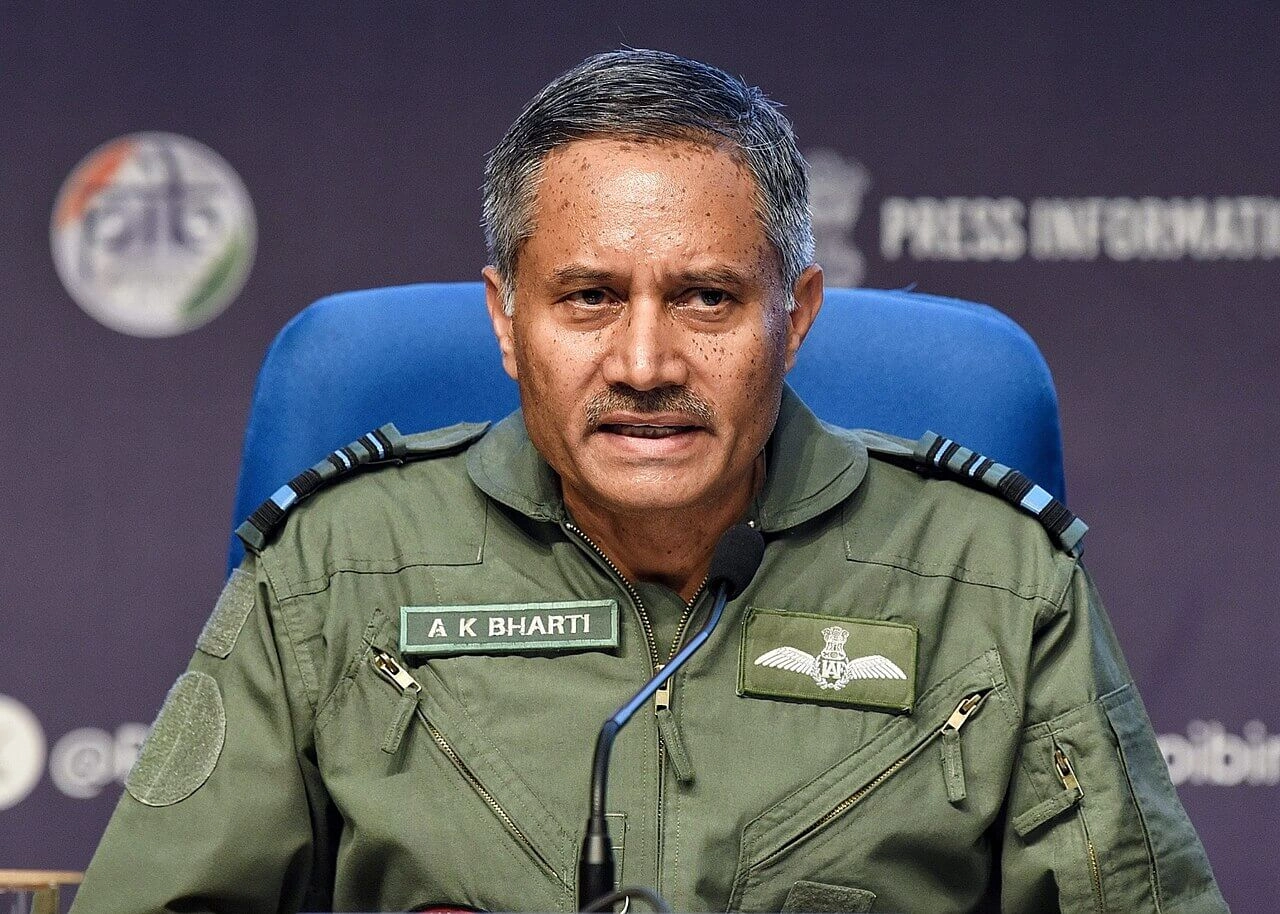
"Air Marshal Bharti" by Unknown authorUnknown author is licensed under CC BY 4.0.
A Ceasefire to the Fighting
On May 10 at 5 PM, India and Pakistan said they would stop fighting. They made a deal for peace on the [[Line of Control::The military control line between India and Pakistan in the disputed region of Kashmir]] (LoC). This came after one week of heavy fighting, [[drone::An unmanned aerial vehicle (UAV) used for surveillance or military purposes]] attacks, and high tension. The fighting started after India’s Operation Sindoor, which was a reply to a [[terror attack::A violent act intended to create fear and intimidation, typically for political or ideological reasons]] in Pahalgam.
But the peace did not last long. Just three hours later, at 8 PM, Pakistan broke the [[ceasefire::A temporary suspension of fighting, typically agreed upon during peace talks or negotiations]]. Loud blasts were heard in Srinagar. The Chief Minister of Jammu and Kashmir, Omar Abdullah, shared this news. India quickly fought back and stopped the attacks.
Later that night, India said if there is more [[terrorism::The unlawful use of violence and intimidation, especially against civilians, in pursuit of political aims]], it will treat it like war. After that, both countries agreed again to stop fighting. Many people are still worried, but right now, the new ceasefire is working.
The Reason Behind This Conflict
The problem began on April 22. There was a terror attack in Pahalgam, Jammu and Kashmir. Twenty-six people died. The attackers were from terrorist groups in Pakistan. People in India were very angry.
India replied by cutting some ties with Pakistan. It also stopped the [[Indus Water Treaty::A treaty signed between India and Pakistan in 1960 to regulate the use of the waters of the Indus River system]]. On May 7, India started Operation Sindoor. Indian soldiers destroyed nine [[terror camps::Locations where terrorist groups train and prepare individuals for carrying out attacks]] in Pakistan and in Pakistan-occupied Kashmir (PoK).
About 70 terrorists died, including some top leaders. India said no soldiers were hurt from the Indian Defence Forces. The mission was fast and successful. But after that, the fighting between India and Pakistan got worse.
What Comes Next
This ceasefire only stops the fighting at the borders. India said it will still use other ways, like [[economic pressure::The use of financial or trade restrictions to influence or force a country or entity to change its behavior or policies]], to make Pakistan act against terrorism.
A very important meeting will happen at 12 PM on Monday, May 12. Army leaders from both countries (called [[DGMOs::Abbreviation for Director Generals of Military Operations, the senior officers who plan and oversee military moves]]) will talk. This meeting may help keep peace or bring more trouble if it fails.
India's Next Steps For Safety
India is being calm but strong. It carried out Operation Sindoor, protected its borders, and spoke with other countries. When the fighting started again, India gave a strong answer. This helped to stop more fighting.
This peace agreement is not forever. It is only a short break. India is ready and says: “No terrorism. No peace without justice.”
Quick Revision
India and Pakistan stopped fighting on May 10 on the Line of Control.
Peace broke after 3 hours, but India replied and fighting stopped again.
Why it began: A terror attack in Pahalgam killed 26 people.
India’s action: Operation Sindoor destroyed terror camps; many terrorists died.
Now: Ceasefire is temporary; talks will decide peace.


